How to Solve Sudoku Faster: 4 Real Techniques (No Guessing)
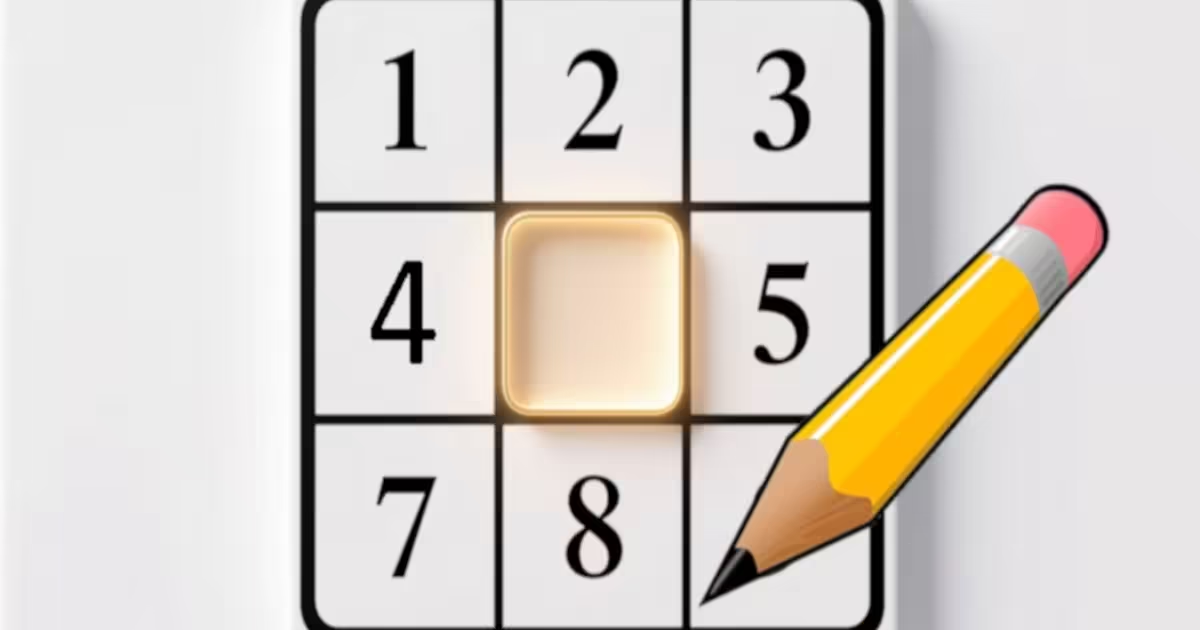
Every solvable Sudoku grid can be finished through pure deduction — no guessing, no trial and error. If you’re stuck staring at a half-finished grid, it’s almost never because the puzzle needs luck; it’s because it needs one of a handful of standard techniques. Here are four that solve most of what you’ll run into in Classic Sudoku.
1. Naked singles
The simplest technique: look at a single empty cell and cross off every number that already appears in its row, column, or 3x3 box. If only one number survives, that’s the answer — it’s the only value that can legally go there.
This is where every solver should start on a fresh grid. It won’t solve the whole puzzle on its own, but it usually unlocks a few cells immediately and often opens up the next technique.
2. Hidden singles
This one flips the naked-single logic around. Instead of asking “what can go in this cell,” ask “where can this number go” within a specific row, column, or box.
Pick a number, say 7, and look at one box. If 7 is missing from that box but only one empty cell in it doesn’t already have a 7 in its row or column, that cell must be 7 — even if, looked at on its own, that cell still seems to have other candidates. The number is “hidden” because you only find it by scanning for where it fits, not by narrowing down one cell in isolation.
3. Pointing pairs
Sometimes a number’s only two (or three) possible positions inside a box all fall in the same row or column. When that happens, that number can be eliminated as a candidate everywhere else in that row or column outside the box.
Example: if a 4 can only go in two cells of a box, and both of those cells sit in the same row, no other cell in that row — outside the box — can be a 4. This doesn’t fill in a number directly, but it narrows candidates elsewhere, which frequently triggers a naked or hidden single somewhere else on the grid.
4. Box-line reduction
The mirror image of pointing pairs. If a number’s only possible cells within a specific row or column all fall inside the same box, that number can be eliminated from every other cell in that box.
This technique and pointing pairs are really the same idea applied in opposite directions — one narrows a row/column based on a box, the other narrows a box based on a row/column. Once both are part of your regular scan, most “medium” difficulty grids stop needing anything else.
What to do when none of these apply
On harder grids, you’ll eventually hit a wall where no cell has a naked single and no number has a hidden single anywhere. That’s the point where more advanced chain-based techniques (X-Wing, swordfish, and so on) come in — genuinely useful, but overkill to learn before the four above are automatic. Get comfortable scanning for these first; they resolve the overwhelming majority of grids you’ll actually encounter.
Practice elsewhere, too
The deduction habit Sudoku builds — eliminate what’s impossible, then see what’s left — carries directly into other logic games on the site:
- Minesweeper Infinite — same elimination-by-counting logic as Sudoku, just applied to mine counts instead of grid numbers.
- Mate in Chess — a different kind of deduction: instead of eliminating candidate numbers, you’re eliminating candidate moves until only the forced sequence remains.
Browse the full logic games category for more of the same kind of thinking, or puzzles if you want a wider mix of mechanics.